Rules and Regulations for Stage Race Sanriku SRS200/100
I. BASIC RULES
1. General Provisions
These Rules and Regulations set forth the requirements governing the 3rd Stage Race Sanriku SRS200/100 (hereinafter referred to as the “Race”), organized by Discover Rias, a nonprofit organization (hereinafter referred to as the “Organizer”), and scheduled to be held from May 1 to May 4, 2027. All participants must agree to comply with these Rules and Regulations.
The objectives of the Race are:
To discover new attractions of the Sanriku region as it continues its recovery from the Great East Japan Earthquake, and to share those attractions with a wider audience.
To promote a new form of sport as a “running journey,” rather than focusing solely on times and rankings.
This is the third event held as part of the development toward Stage Race Sanriku SRS311, a 311 km stage race planned across Iwate and Miyagi Prefectures.
All participants are asked to understand and support the purpose of the Race.
2. Basic Responsibilities of Participants
The Race takes place in public areas, including urban areas and mountain environments, which are not closed exclusively for the event. Participants must comply with all applicable laws and regulations and act in accordance with generally accepted standards of conduct, even while participating in the Race.
Participants must treat other participants, local residents, members of the public, volunteers, race staff, and all other persons involved in the Race with respect at all times.
Much of the area in which the Race is held lies within Sanriku Fukko National Park, while other sections also contain valuable coastal and mountain environments. Participants are expected to act responsibly to protect Sanriku’s rich natural environment and to coexist respectfully with nature.
The Organizer will operate the Race with due consideration for participant safety. However, participants are expected to be prepared to deal with adverse weather, accidents, natural disasters, and other unexpected situations. Participants are also responsible for managing their own health and physical condition.
II. ELIGIBILITY
Participants must meet all of the following requirements:
Be at least 18 years of age at the time of the Race and be in good physical and mental health.
Understand the purpose of the Race; enjoy the nature, scenery, and culture of the Sanriku and Rias Coast region; and be willing to share the attractions of the region both within Japan and internationally.
Comply with all applicable laws and race rules and take responsibility for their own actions, including in the event of an accident or an incident causing inconvenience or harm to others.
Have the physical fitness, self-management skills, judgment, mental resilience, equipment, and other capabilities necessary to complete the Race safely.
Be capable of understanding and navigating the route using the paper maps and GPX data provided in advance.
Participants residing outside Japan must have valid travel medical insurance that provides coverage in Japan for medical treatment for injury or illness arising during participation in the Race, emergency medical evacuation, and repatriation to their home country. Participants are responsible for confirming that participation in the Race is covered by their insurance policy.
III. RACE RULES
1. Race Overview
All participants will start together each day and compete within the same designated time period.
SRS200: 4 days / approximately 200 km
*Day 1 — May 1 (Approximate distance: 50 km)
6:30–7:30 — Registration: Miyako Station (Sanriku Railway / JR)
8:00 — Start: Jodogahama, Miyako City
18:00 — Finish cut-off: Rikuchu-Yamada Station area, Yamada Town
Overnight stay: Yamada Town
Recommended accommodation: Iwate Prefectural Rikuchu Kaigan Youth House
*Day 2 — May 2 (Approximate distance: 50 km)
6:00 — Start: Rikuchu Kaigan Youth House, Yamada Town
16:30 — Finish cut-off: Kamaishi Civic Hall TETTO, Kamaishi City
Overnight stay: Kamaishi City
Recommended accommodation: Hotel Route-Inn Kamaishi / Owataripanshon
*Day 3 — May 3 (Approximate distance: 60 km)
6:00 — Start: Kamaishi Civic Hall TETTO
18:00 — Finish cut-off: Iwate Prefectural Outdoor Activity Center, Rikuzentakata City
Overnight stay: Rikuzentakata City
Recommended accommodation: Iwate Prefectural Outdoor Activity Center
An evening social gathering is planned.
*Day 4 — May 4 (Approximate distance: 40 km)
6:00 — Start: Rikuzentakata City
16:00 — Finish cut-off: Kesennuma Port Inner Bay, Kesennuma City
SRS100: 2 days / approximately 100 km
SRS100 follows the same itinerary as Days 1 and 2 of SRS200.
Locations, distances, and times are subject to change.
The Race will be conducted in an orienteering-style format. Participants must visit the designated checkpoints (“CPs”) in the specified order based on the information provided by the Organizer.
Routes between CPs are generally not prescribed. However, for safety management purposes, the Organizer may designate specific sections or provide directions using race staff, signs, course markings, or other means. Participants must follow all such designated routes and instructions.
Participants will be provided in advance with information necessary for the Race, including location data for CPs and an overall map. Participants may use other information sources, online searches, mapping applications, and similar tools at their own responsibility.
There are two types of CPs: staffed and unstaffed. Passage through a staffed CP will be confirmed by race staff. Passage through an unstaffed CP may be confirmed by taking a designated photograph or by another method specified by the Organizer.
Some sections of the Race may require participants to travel by designated public transportation, including the Sanriku Railway and JR Ofunato Line BRT.
Participants are free to ask local residents for directions to CPs or information about which way to proceed. As this Race is intended to be a “journey,” participants are encouraged to interact with local communities.
2. Categories, Timing and Rankings
The Race includes the following categories:
Pair - Mixed Pair, Women’s Pair, Men’s Pair
Solo - Women’s Solo, Men’s Solo
The course includes both timed competition sections and untimed transfer sections. Rankings in each category will be determined by the total elapsed time recorded across all timed competition sections.
Results will be announced as follows:
Overall: 1st to 3rd place
1st place in each category: Mixed Pair/ Women’s Pair/ Men’s Pair/ Women’s Solo/ Men’s Solo
Daily results will be posted as appropriate.
In the Pair categories, timing at cut-off points and at the finish will be based on the time at which the second member of the pair passes the timing point or reaches the finish.
3. Cut-off Times and Withdrawal
Cut-off times will be established at the finish of each race day and at certain CPs. If a participant fails to meet a cut-off time, their race for that day will end. However, they may participate again on subsequent race days.
Except in the case of an accident, natural disaster, or other emergency, participants may withdraw only at designated locations where withdrawal is permitted (“Withdrawal Points”). Even if a participant fails to meet a cut-off time, they must continue to the next Withdrawal Point.
Participants who fail to meet a cut-off time will be transported from the Withdrawal Point to that day’s finish location. Participants must carry sufficient warm clothing, food, and other supplies necessary for this situation. Any public transportation costs incurred will be at the participant’s own expense.
If a participant is judged to require medical assistance, first aid will be provided. Any additional treatment, medical care, or related expenses will be the responsibility of the participant.
If the Organizer determines that a participant cannot safely continue the Race, the Organizer may require the participant to stop racing immediately.
If one member of a Pair withdraws, the remaining participant may continue alone. However, the remaining participant will not be recognized as an official Solo finisher.
4. Disqualification and Penalties
If a participant violates equipment requirements or rules of conduct, the Organizer may impose a time penalty on the participant at the time of the violation.
In the event of a serious violation, the Organizer may disqualify the participant. A disqualified participant may not take part in any subsequent portion of the Race.
Failure to pass through a required CP may result in a time penalty.
5. Cancellation or Suspension
The Organizer may cancel or suspend the Race, change checkpoints, or make other necessary changes if it determines that it is difficult to hold or continue the Race.
Such circumstances may include:
The issuance of disaster-prevention weather information at Level 3 or above.
An earthquake of seismic intensity 5-lower or greater, or the issuance of a tsunami warning or tsunami advisory.
The issuance of an Earthquake Early Warning or earthquake prediction information.
Severe weather, hazardous road or trail conditions, or other circumstances in which participant safety or protection of the natural environment cannot be ensured.
Confirmation of the presence of bears or other dangerous wildlife in or near the race area.
Any other circumstances in which the Organizer determines that the Race should be cancelled or suspended.
6. Course Conditions and Equipment
Terrain and Weather Conditions in the Race Area
Approximately 60% of the course is on paved roads; however, the Race also takes place in natural environments, including mountainous areas.
Participants must familiarize themselves with the terrain and weather conditions of the race area and must carry all mandatory and other necessary equipment.
Participants are responsible for their own safety during the Race, including dealing with injuries, getting lost, deteriorating weather conditions, and other unexpected situations.
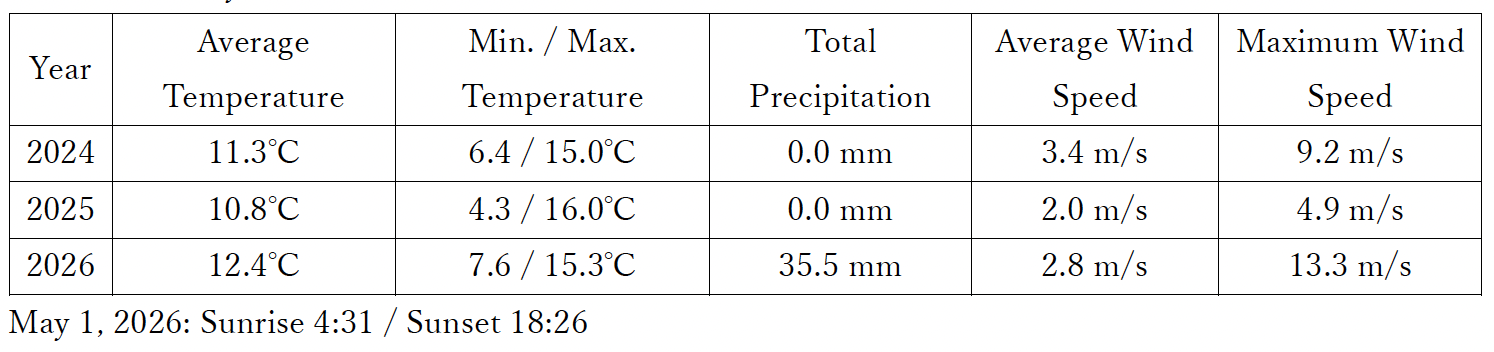
Weather Conditions at the Start — Miyako City
Records for May 1, 2024–2026
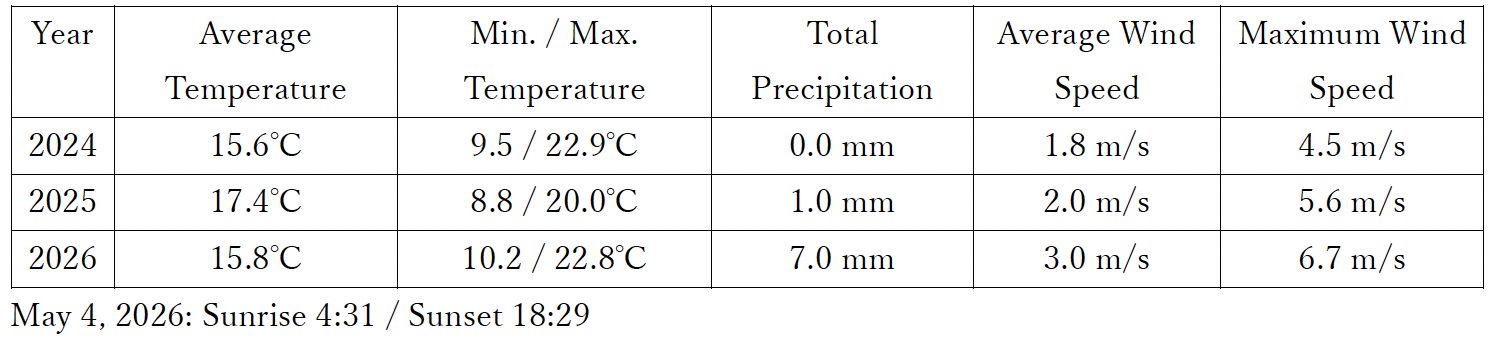
Weather Conditions at the Finish ̶ Kesennuma City
Records for May 4, 2024‒2026
Weather data is based on information provided by the Japan Meteorological Agency.
The highest point on the course is approximately 610 m above sea level. Air temperature is generally said to decrease by approximately 0.6℃ for every 100 m increase in elevation. Wind chill may also make the perceived temperature approximately 1℃ lower for each 1 m/s increase in wind speed.
Mandatory Equipment
Based on the conditions described above, participants must carry or wear the following equipment at all.
Times during the Race:
Smartphone: The smartphone must remain switched on throughout the Race. Airplane mode must not be used.
Compass: A smartphone compass application is permitted.
Electronic device capable of displaying the route using GPX-format GPS data provided by the Organizer: A smartphone application may be used.
Camera: A smartphone camera is permitted.
Portable battery/ power bank and charging cable: Participants must carry sufficient battery capacity to keep their smartphone operational throughout the Race. Please note that battery consumption may increase when mapping applications are running or when temperatures are low.
Light and spare battery: A headlamp, handheld light, or similar light source is permitted. For rechargeable lights, a portable battery may be used as the spare battery, provided that it has sufficient capacity to charge both the smartphone and the light.
Flashing safety light visible from behind
Bear bell: Solo participants are recommended to carry at least two bear bells. Bear bells must not be used in urban areas.
Whistle
Emergency/ survival blanket
First-aid kit
Athletic tape/ sports tape
Rain jacket: Must be waterproof and breathable, with waterproof seam taping.
Rain pants: Must be waterproof and breathable, with waterproof seam taping.
Long-sleeved shirt for warmth
Water: Participants must carry at least 500 ml of water when leaving the start and each aid station.
Food/ nutrition for use during the Race
Reusable cup: Paper cups will not be provided at aid stations.
Proof of medical insurance
Residents of Japan: A My Number Card registered for use as a Health Insurance Certificate, a Health Insurance Eligibility Certificate, or other proof of health insurance eligibility.
Participants residing outside Japan: Proof of valid travel medical insurance in Japan. Digital proof on a smartphone is acceptable.
Trash bag for waste generated during the Race
Race bib: Provided by the Organizer.
GPS tracking device: Provided by the Organizer. One device will be provided per Pair.
Recommended Equipment
Trail running shoes
Long pants for warmth
Gloves for warmth and protection
Hat or cap for warmth and protection
Cash
Portable toilet
Bear spray
Equipment Checks and Restrictions
Equipment checks may be conducted during the Race. Participants who are found not to be carrying mandatory equipment may be disqualified or receive a time penalty.
The use of poles or trekking poles is not permitted.
The use of earphones during the Race is prohibited.
7. Rules of Conduct
Race Conduct
Participants must comply with all traffic laws and regulations throughout the course, including at traffic signals and road crossings, regardless of whether they are in a timed competition section or an untimed transfer section.
Where a sidewalk is available, participants must use the sidewalk. On roads without a sidewalk, participants should, in principle, travel on the right-hand side of the road.
Except when using public transportation designated by the Organizer, participants must not use any means of transportation other than their own feet, including bicycles, motor vehicles, scooters, or similar means.
When overtaking or passing pedestrians, hikers, mountaineers, or other members of the public on the course, participants must slow down in a safe location with sufficient space, offer a brief greeting, and pass them at walking pace.
Participants must take care not to damage any public property or facilities along the course. If any damage occurs, participants must promptly report it to the Organizer.
In the Pair categories, the two members of each Pair should, in principle, remain together
throughout the Race.
Safety
If a participant becomes unable to continue as planned due to illness, injury, or any other physical condition during the Race, the participant’s safety must take priority over continuing the Race.
If a participant encounters another participant, race staff member, local resident, or other person who has stopped due to illness or injury, they must check on that person’s condition. If rescue or assistance is required, providing such assistance must take priority over continuing the Race.
If a participant encounters a bear or other dangerous wildlife, or becomes aware of a hazardous condition on the course, they must report the situation to Race Headquarters.
In the event of a natural disaster or other emergency, participants must promptly evacuate to a safe location.
Environmental Conduct
Littering is strictly prohibited. Participants must take particular care not to accidentally drop small pieces of food packaging or other waste that they may believe they have placed securely in a pocket.
Participants must not collect, remove, or damage plants, animals, rocks, soil, or other natural features.
On mountain paths and trails, participants must take care not to damage vegetation or soil.
Participants must use toilets provided at aid stations, public toilets, or portable toilets. Urination or defecation along the course is prohibited.
IV. RACE OPERATIONS
1. Aid Stations
Drinks and food will be provided at aid stations. The use of open flames is prohibited.
Participants may use vending machines and shops during the Race.
Personal assistance from supporters is permitted only at aid stations.
2. Baggage
On each race day, participants may leave their baggage at the start location and collect it at the finish location for that day.
Baggage to be transported must be consolidated into a single item.
Even if a participant withdraws during the course of the day, their baggage must be collected at that day’s finish location.
3. Organizer’s Responsibilities
The Organizer assumes responsibility for the following:
Matters specified in these Rules and Regulations, including the provision of aid stations and course markings.
Damage to property occurring during the Race that is not caused by any intentional or negligent act of a participant, including damage to facilities on trails.
The Organizer will provide domestic travel accident insurance coverage for all participants, including participants residing outside Japan. Participants are also advised to obtain their own additional insurance coverage.
Insurance Coverage
Death: JPY 5,000,000
Surgery:
JPY 50,000 for surgery requiring hospitalization
JPY 25,000 for outpatient surgery
Hospitalization: JPY 5,000 per day
Outpatient treatment: JPY 3,000 per day
All matters other than those stated above are at the participant’s own risk and responsibility.
V. ENTRY
1. Entry
Entry Information
Number of Participants: A total of 150 participants for SRS200 and SRS100 combined.
How to Enter: Applications must be submitted through the official entry site for the 3rd Stage Race Sanriku SRS200/100.
Entry platforms: Sports Entry
Entry Period:
Participants residing outside Japan
December 1, 2026 – January 31, 2027
Entry Fees:
Participants residing outside Japan
SRS200 — 4 days Solo: JPY 60,000 per person
Pair: JPY 105,000 per pair
SRS100 — 2 days Solo: JPY 44,000 per person
Pair: JPY 75,000 per pair
Accommodation is not included in the entry fee.
Entries will close once the maximum number of participants has been reached. Applications will be accepted on a first-come, first-served basis.
Additional entries may be accepted if places become available due to cancellations, unpaid entry fees, or other circumstances after the initial entry period.
2. Cancellation
Entry fees will not be refunded in the event of cancellation by the participant.
As a general rule, entry fees will not be refunded even if the Race is cancelled.
3. Changes to Pair Members and False Information
Participation by anyone other than the registered participant is not permitted. Providing false information regarding place of residence, age, gender, race results, or other application details is also prohibited. If such a violation is discovered, the participant will be disqualified and their entry will be cancelled.
In the Pair categories, if one member of a Pair becomes unable to participate and the team wishes to replace that member, the team must contact the Race Office and submit a request for a change of participant. Approval of any such change is at the discretion of the Organizer.
VI. OTHER PROVISIONS
1. Personal Information and Use of Photographs and Video
Personal information provided by applicants will be handled in accordance with the Organizer’s Privacy Policy.
Photographs and video footage taken during the Race by the Organizer or persons authorized by the Organizer may be used for promotional, documentary, reporting, and other race-related purposes, including in newspapers, magazines, television, websites, social media, and other media. By entering the Race, participants consent to such use.
2. Amendments and Updates to These Rules and Regulations
These Rules and Regulations were originally established on September 10, 2026 and revised on November 6, 2026.
The Rules and Regulations may be amended or updated in response to changes in social conditions, including major natural disasters, infectious diseases, or other circumstances.
The Race will be conducted in accordance with the most current version of these Rules and Regulations in effect at the time of the event.